PLANT-POWERED · PROTEIN-PACKED · DAILY
Stuffed Butternut Squash with Chickpeas and Cauliflower Crumble — הספורטאי הטבעוני
Back to recipes
This recipe was machine-translated. A few bits might be off.

Stuffed Butternut Squash with Chickpeas and Cauliflower Crumble

16 במאי 2020 8 min read
Share:
Total time
80 min
Prep 20m · Cook 60m
Difficulty
Medium
Servings
2

Cooked it? Tap so others can find it.

שמירה ושיתוף:

Butternut Squash: The Full Guide — Nutritional Values, Oven Roasting, and a Stuffed Recipe

Butternut Squash — The Complete Guide: Nutrition, Cutting, Roasting, and Recipes

Butternut squash is a sweet, orange vegetable from the gourd family, particularly popular in healthy and vegan diets. In this guide, you'll find everything you need to know about butternut squash: how to peel and cut it, how to roast butternut squash in the oven for the best flavor, its nutritional values, the difference between butternut squash and pumpkin, and of course, an indulgent recipe for butternut squash stuffed with chickpeas and cauliflower crumble.

Nutritional Value of Butternut Squash

Butternut squash is relatively low in calories and rich in important nutrients. In 100g of cooked butternut squash, you will find approximately:

  • Calories: about 40 kcal
  • Carbohydrates: about 10g (including about 2g of dietary fiber)
  • Protein: about 1g
  • Fat: less than 0.5g
  • Vitamin A: very high amount (beta-carotene)
  • Vitamin C, Potassium, Magnesium, and Antioxidants

Thanks to its relatively low carbohydrate percentage and high amount of dietary fiber, butternut squash is suitable for those following a low-carb diet as well as athletes looking for quality carbohydrates for recovery.

What is the Difference Between Butternut Squash and Pumpkin?

Butternut squash and pumpkin are both from the gourd family, but there are important differences between them:

  • Size: Butternut squash is much smaller than a pumpkin and usually weighs 1-2 kg.
  • Texture and Taste: Butternut squash is sweeter, more buttery, and creamier than pumpkin.
  • Skin: The skin of a butternut squash can be eaten after roasting — with pumpkin, this is almost impossible.
  • Calories: Both are low in calories, but butternut squash is slightly richer in simple carbohydrates.

If you're wondering which is more fattening, pumpkin or butternut squash — both are excellent for weight loss, but pumpkin has slightly fewer calories per 100g.

How to Cut and Peel Butternut Squash Easily

Cutting butternut squash can seem intimidating, but there's a simple method:

  1. Washing: Rinse the squash well under running water.
  2. Stabilizing: Slice a thin piece off the base so it stands stable on the cutting board.
  3. Halving: Using a sharp chef's knife, cut the squash lengthwise into two halves.
  4. Deseeding: Use a large spoon to scrape out the seeds and fibers from the center.
  5. Cubing: Cut into wedges and then into cubes of your desired size.

Do you need to peel butternut squash? Not necessarily. The skin is thin and soft after roasting, and rich in fiber. If you still prefer to peel it — it’s easier to peel after a short 10-15 minute roast in the oven once the skin softens.

How to Roast Butternut Squash in the Oven — The Best Method

Roasting butternut squash in the oven is the easiest and tastiest way to prepare it. Here is how to do it right:

  1. Preheat the oven to 200°C on fan mode.
  2. Halve the squash, remove the seeds, and place it on a tray lined with parchment paper, cut side up.
  3. Roast for 40-50 minutes without any additions — no oil, no salt, nothing. The squash cooks in its own juices and comes out buttery and sweet.
  4. When the skin browns slightly and the flesh is soft when pierced with a knife — it's ready.

Tip: You can roast butternut squash whole without cutting it — just prick it with a fork in several places and roast for about an hour. It comes out exceptionally creamy this way.

The Recipe: Stuffed Butternut Squash with Roasted Chickpeas and Cauliflower Crumble


Butternut squash, my love — a magical, wonderful vegetable.

Why?

First of all, even though it's orange like a sweet potato and they can easily be confused after cooking, butternut squash contains significantly fewer carbs and calories than sweet potatoes.

Like sweet potato, it also contains a bounty of essential minerals, vitamins, and antioxidants.

I love roasting butternut squash whole. Just like that.

Place it in the oven on a baking tray and let it cook in its own juice.

Trust me, you don't need anything: no oil, no salt.

Just an oven, high heat, and time. C'est tout.

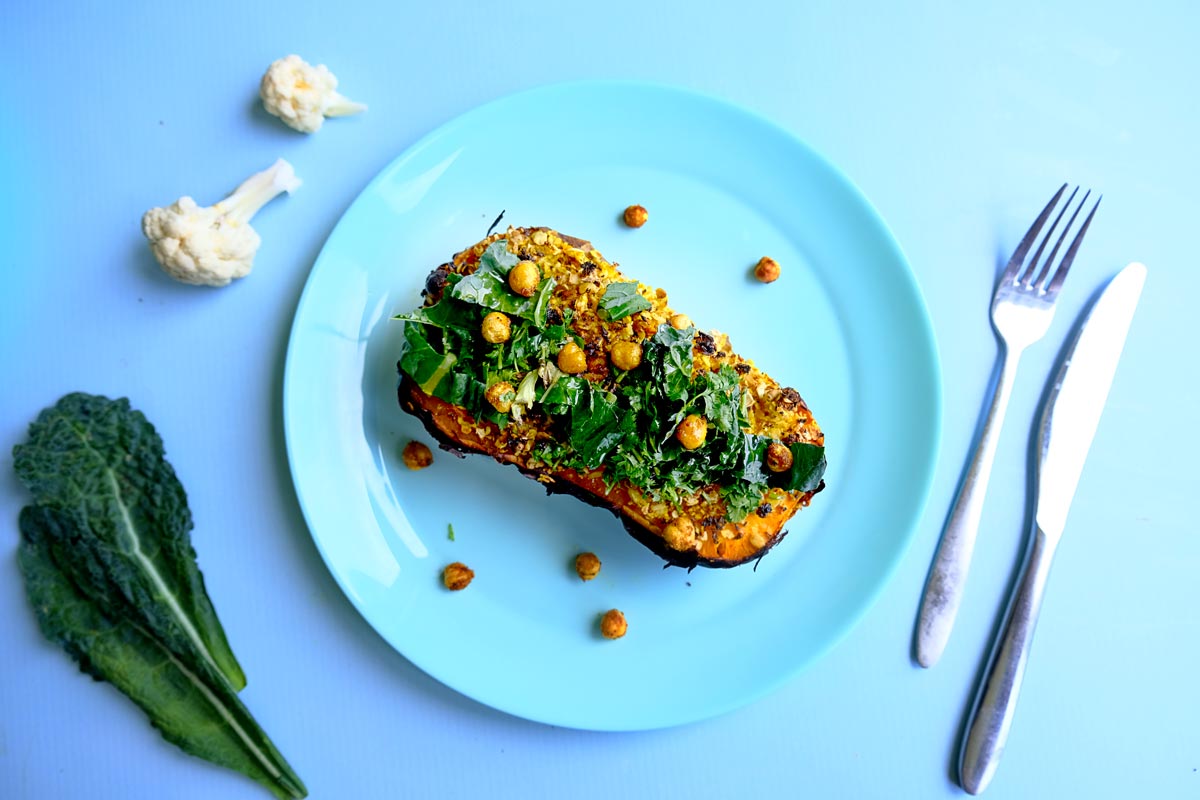
In this recipe, I've upgraded the squash slightly and stuffed it with crunchy roasted chickpeas, along with a cauliflower and oat crumble.

I added a few extras like crushed tomatoes with garlic and a small cilantro and kale salad on top, to make it look festive and feel satisfying.

A little bit of effort and you have a beautiful and interesting first course or main dish for the holiday table, Friday night, or when you just want to treat someone you love.

Look at these ingredients!

A Bit More About Stuffed Butternut Squash

This recipe is based on a whole oven-roasted butternut squash. You can swap it for acorn squash or if you find another type of pumpkin, go for it.

Between the roasted chickpeas and the squash, I added a bit of crushed tomatoes with garlic to add juiciness to the dish (the same kind of tomatoes served with Jachnun).

Don't like tomatoes?

No problem: replace them with an eggplant salad, mashed zucchini with garlic, or even green tahini. Go with the flow. The main thing is to create juiciness.

The chickpeas I used are canned, but you can happily use frozen ones or even those you've cooked yourself.

Don't like chickpeas? You can substitute with a can of kidney beans, lupini beans, green peas, or tofu cubes (I could go on, but I think you get the picture.)

The cauliflower and oat crumble is a festive option that provides crunch and a fun flavor addition.

I added oats so they would absorb the flavors of the sauce along with the cauliflower. Want to save 25 calories per serving? Leave them out.

The cilantro and kale salad at the top of the tower is the cherry on top and brings freshness to the entire dish.

Don't want kale or cilantro? Make a salad out of whatever you like.

Butternut squash stuffed with chickpeas and cauliflower crumble
Juicy!

Nutritional Values for Stuffed Butternut Squash by Nutritionist Noam Bachar:

A serving of half a butternut squash with 100g of chickpeas at a total weight of 400g contains:

  • 410 calories
  • 12g protein
  • 43g carbohydrates
  • 22g fat (of which 3g saturated fat)

Want another festive recipe for Shavuot? Click here

\"Butternut

Stuffed Butternut Squash with Chickpeas and Cauliflower Crumble

A festive, beautiful, and exceptionally healthy dish

Prep time 20 minutes
Cook time 1 hour
Servings 2 servings
Calories 410 kcal

Ingredients

  • 1 Medium whole butternut squash
  • 3/4 can Cooked chickpeas 200g
  • 1 tsp Cumin
  • 2 tsp Turmeric
  • 1 tsp Chili flakes
  • A pinch of salt
  • Juice of one whole lemon
  • 4 tbsp Olive oil
  • 2 Grated tomatoes Grated on a grater
  • 3 Crushed garlic cloves
  • 3-4 Cauliflower florets 50g
  • 3 tbsp Quick oats 33g
  • A pinch Chopped cilantro
  • A pinch Chopped kale

Instructions

  1. Preheat the oven to 220°C.

  2. Place the butternut squash whole, just as it is without cutting it, on a baking tray and roast for about an hour until softened. The skin will burn completely; this is fine.

  3. While the squash is in the oven, combine one teaspoon of cumin, one teaspoon of turmeric, one teaspoon of chili flakes, a pinch of salt, and 2 tablespoons of olive oil in a bowl and mix well.

  4. Add the chickpeas and mix well.

  5. Transfer the chickpeas to the baking tray and spread them out with a spoon.

  6. Roast in the oven for about half an hour until the chickpeas are crispy.

  7. Pulse the fresh cauliflower florets in a food processor until they have an "rice" texture. Don't process them too much, or you'll get a puree (unless that's what you want).

  8. In a bowl, mix the cauliflower with the oats, a tsp of cumin, juice from half a lemon, 2 crushed garlic cloves, 2 tbsp of olive oil, and a pinch of salt.

  9. Grate the tomatoes and add 2 crushed garlic cloves.

Assembling the Squash:

  1. Halve the butternut squash on the baking tray.

  2. Remove the seeds using a spoon.

  3. Fill the cavity of the squash with the crushed tomatoes, top with the roasted chickpeas, and then the cauliflower crumble.

  4. Return the squash to the oven for another 15 minutes of roasting until the crumble is browned.

  5. Before serving, top with some chopped cilantro and kale and a squeeze of lemon juice.

Recipe Video

More Ideas for Butternut Squash Recipes

  • Creamy Butternut Squash Soup — Squash with onion and garlic, blended into a comforting soup.
  • Oven-Roasted Spiced Butternut Squash — Cubes with smoked paprika, cumin, and maple syrup.
  • Roasted Butternut Squash Salad — With arugula, toasted pumpkin seeds, and tahini dressing.
  • Butternut Squash Mash — Roasted squash mashed with raw tahini and cumin.

Frequently Asked Questions About Butternut Squash

Is butternut squash a carbohydrate?

Yes, most of the calories in butternut squash come from carbohydrates, but it is a complex carbohydrate rich in fiber — an excellent choice even in lower-carb diets compared to potatoes or white rice.

How long do you roast butternut squash in the oven?

Halved squash: 40-50 minutes at 200°C. Whole squash: about an hour. Cubed squash: 30-35 minutes.

Can you eat the skin of a butternut squash?

Yes. The skin is thin, softens during roasting, and is rich in fiber and antioxidants. Just wash it well.

How do you store butternut squash?

Whole — up to a month in a cool place. Cut — up to 5 days in the refrigerator. Cooked — up to 4 days in the refrigerator or two months in the freezer.

Is butternut squash diet-friendly?

Absolutely. At about 40 kcal per 100g, it is filing thanks to the fiber and provides essential vitamins and minerals.

3 more you might love

Next recipe

Skip to main content